An AI CRM is a customer relationship management system that uses machine learning and language models to do the tedious parts of selling: finding prospects that match your ideal customer, enriching their details, writing personalised outreach, and scoring which deals are most likely to close. For a B2B startup without a large sales team, that can be the difference between a full pipeline and a spreadsheet nobody updates.
- Start by defining your ideal customer profile (ICP) in concrete, filterable terms.
- An AI CRM should cover the whole loop: find leads, reach out, follow up, score and report.
- Personalisation only works when it is grounded in real data about the prospect.
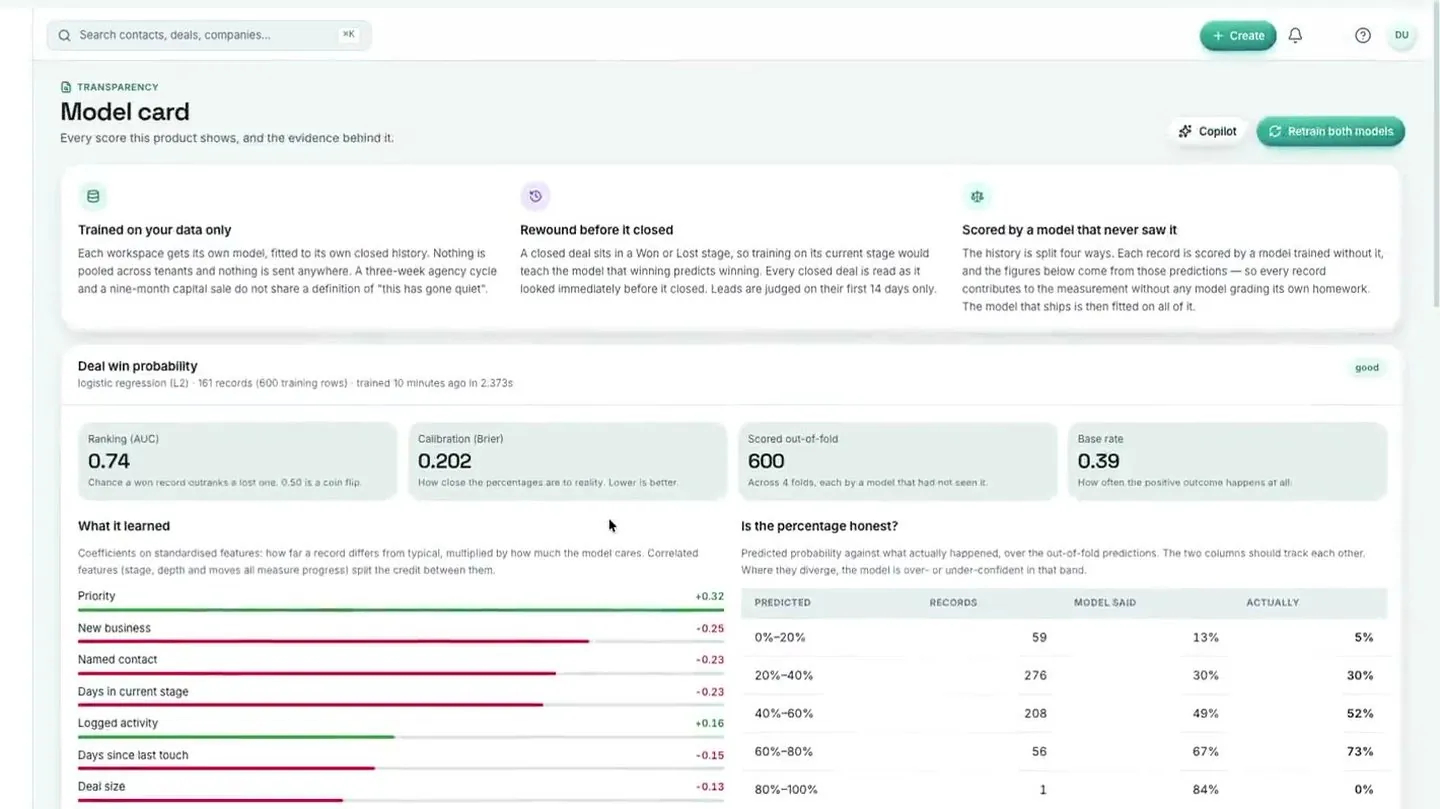
- Deal scores are only useful if they are calibrated and explained, not just a number.
- Check data ownership: your history should train only your own models.
Why traditional CRMs struggle with lead generation
Traditional CRMs are systems of record. They are good at storing contacts and deals once you have them, but the work of finding leads, writing emails and remembering follow ups happens in other tools, or in someone's head. Data entry falls behind, the pipeline goes stale and nobody trusts the forecast.
An AI CRM moves the CRM from record keeping to doing the work: generating the pipeline, not just storing it.
What an AI CRM does, step by step
1. Define your ideal customer profile
Everything starts with a clear ICP: industry, company size, region, roles you sell to, technologies they use, and the signals that suggest they need you now. Write down who is not a fit too. Vague ICPs produce vague lists.
2. Find and enrich leads
The system finds companies and contacts matching the ICP and enriches them with firmographic details, so every lead arrives with enough context to judge fit and personalise outreach.
3. Personalised outreach and follow ups
Language models draft emails tailored to each contact's company and role, sent from your own mailboxes, with timed follow ups until someone replies. Personalisation should reference something real about the prospect. Generic AI copy at scale is just faster spam.
4. Qualification and deal scoring
Once conversations start, the CRM tracks each opportunity through your stages and estimates its probability of closing. Good scoring explains itself (which factors pushed the score up or down) so a salesperson can act on it.
5. Revenue analytics and next actions
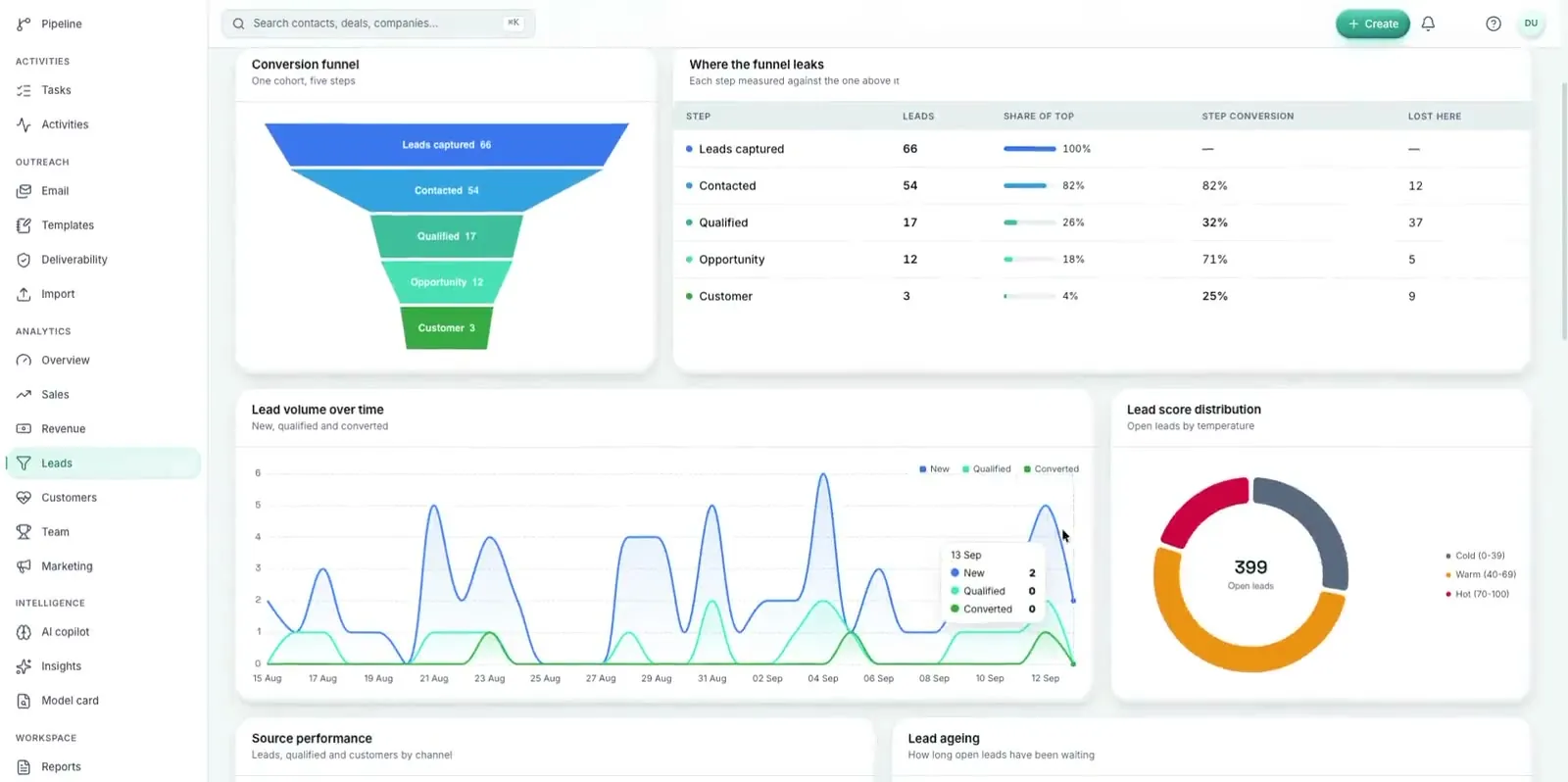
Funnel and pipeline analytics show where deals stall, and an AI copilot recommends what to do next: which deal has gone quiet, which follow up is overdue, which opportunity carries the most value.
Find where your funnel leaks
Most B2B funnels do not leak evenly. Measuring each step against the one before it shows where effort is wasted. A typical pattern looks like this:
| Step | What it measures | If conversion is low |
|---|---|---|
| Leads captured → contacted | Outreach coverage | Automate first touches and follow ups |
| Contacted → qualified | ICP fit and message relevance | Tighten the ICP, improve personalisation |
| Qualified → opportunity | Discovery and value proposition | Sharpen the offer and the demo |
| Opportunity → customer | Closing, pricing, timing | Focus on high probability, high value deals |
In many early stage funnels the biggest drop is between contacted and qualified, which usually means the list or the message is off, not that the team needs to send more emails.
What to look for in an AI CRM
- One workspace for the whole loop, from first lead to closed won, rather than five stitched tools.
- Outreach from your own mailboxes, with deliverability controls and sensible sending limits.
- Explainable, calibrated scoring. Ask how scores are validated and whether you can see the evidence.
- Data isolation. Your deal history should train your models only, never be pooled across customers.
- Pricing that fits a startup, ideally per workspace rather than per seat.
- Customisation: fields, stages and automations that match how you actually sell.
Risks and how to avoid them
- Deliverability damage. Too many cold emails too fast hurts your domain. Ramp slowly and keep lists clean.
- Compliance. Follow the email and data protection rules of the regions you sell into, such as the GDPR in Europe.
- Over automation. Keep a human in the loop for replies and important accounts.
- Unverified claims. Be sceptical of vendors promising fixed uplift percentages without published evidence.
How we built Caudify CRMS
We built Caudify CRMS for startups looking for new clients. In one workspace it finds and enriches leads, writes and sends personalised emails from your own mailboxes with timed follow ups, and tracks every deal to revenue. Every workspace gets its own win model, trained only on that workspace's closed deals, and the model card shows the evidence behind every score. Plans are priced per workspace, starting at $39 a month billed yearly.
It is delivered as Product as a Service: we host, maintain and tailor it with you. If you already run HubSpot or another CRM and want AI working inside it, our AI integration services connect it to the rest of your stack.
Frequently asked questions
What is the difference between an AI CRM and a traditional CRM?
A traditional CRM stores contacts and deals that people enter. An AI CRM also does the work around them: it finds and enriches leads, drafts personalised outreach, schedules follow ups, scores deals and recommends next actions. The goal is a pipeline that fills and updates itself, rather than a database that depends on manual entry.
Is AI email outreach compliant with GDPR?
It can be, if it is done carefully. B2B outreach in Europe generally relies on legitimate interest, which means contacting relevant roles, explaining why, making opting out easy and honouring it, and keeping data accurate. Rules differ by country, so check the requirements for each region you sell into.
How much does an AI CRM cost for a startup?
Pricing varies widely, from per seat plans to per workspace plans and usage based pricing for data and sending. Caudify CRMS is priced per workspace, not per seat, starting at $39 a month billed yearly for up to two users, so small teams are not penalised for adding people.
Start small
- Write down your ICP in one page.
- Pick one segment and one offer.
- Run outreach to a few hundred well chosen contacts, not thousands.
- Measure each funnel step for a month, then fix the biggest leak.
Want to see it on your own ICP? Book a live CRMS demo. And if you are weighing an agent against simpler automation for your sales process, read AI agents vs chatbots vs workflow automation.