A chatbot answers questions in a conversation. Workflow automation runs a fixed sequence of steps the same way every time. An AI agent is given a goal and a set of tools, and decides which steps to take to reach it, checking results as it goes. The three are often sold under the same label, which is why so many AI projects start with the wrong one.
- Chatbots talk: they answer, retrieve information and collect details.
- Workflow automation executes: predictable steps, triggered by events, with no judgement.
- AI agents pursue goals: they plan, use tools across systems and handle messy inputs.
- Use the simplest option that works. Deterministic automation is more reliable than an agent when the steps never change.
- Most real systems are hybrids: fixed workflows with an agent only where judgement is needed.
The short version
| Chatbot | Workflow automation | AI agent | |
|---|---|---|---|
| Main job | Answer and converse | Execute fixed steps | Reach a goal |
| Who decides the steps | The user, turn by turn | The person who built the flow | The agent, within limits you set |
| Handles messy inputs | Somewhat | Poorly | Well |
| Takes actions in other systems | Rarely | Yes, scripted | Yes, chosen per task |
| Predictability | Medium | High | Lower, needs guardrails |
| Typical example | Website FAQ assistant | New invoice → accounting system | Research a lead, draft outreach, update the CRM |
What is a chatbot?
A chatbot is a conversational interface. Older chatbots follow menus and scripts; modern ones use a language model to understand free text and answer from your documentation or knowledge base. They are a good fit for high volume, low risk questions: support FAQs, product questions, booking information and collecting details before handing off to a person.
The limit is that a chatbot mostly responds. It waits for the user, and even when it can look something up, it rarely completes a multi step task on its own.
What is workflow automation?
Workflow automation connects systems with predefined rules: when this happens, do that. A new form submission creates a CRM record and sends a welcome email. An approved invoice is posted to accounting. Tools like n8n, or durable workflow engines such as Temporal for critical processes, make these flows reliable, observable and easy to retry.
Automation is deterministic, which is its strength. When the steps never change, a workflow is cheaper, faster and more predictable than any AI. Language models can still help inside a workflow, for example to extract fields from a document, without making the whole flow autonomous.
What is an AI agent?
An AI agent is a language model given a goal, a set of tools (APIs, databases, other software) and some memory. It plans the steps, calls tools, looks at the results and adjusts. That lets it handle tasks where the path is not known in advance: messy inputs, judgement calls and work that spans several systems.
Agents can also work in teams. In a multi agent system, specialist agents (research, drafting, checking) are coordinated by a supervisor. Standards such as the Model Context Protocol (MCP) let agents use your systems as safe, typed tools without one off integrations.
The trade off: autonomy needs guardrails
Autonomy is useful and risky in equal measure. Safe agents get only the tools and permissions a task needs, require human approval for high impact actions, run within step and spend budgets so they cannot loop forever, and log every step so behaviour can be audited. Without those, an agent is a demo, not a system.
How to choose: five questions
- Are the steps always the same? If yes, use workflow automation.
- Is the main need answering questions? If yes, start with a chatbot over your knowledge base.
- Do inputs vary wildly, or require judgement? That is where an agent earns its place.
- What does a mistake cost? The higher the cost, the more you need approvals, or a deterministic flow.
- Which systems must it act in? Every system needs a safe, permissioned tool, so count them early.
Real examples by function
| Task | Best fit | Why |
|---|---|---|
| Answer product questions on the website | Chatbot | High volume, conversational, low risk |
| Sync new orders into accounting | Workflow automation | Identical steps every time |
| Extract fields from varied supplier invoices | Automation with an AI step | Fixed flow, messy input in one step |
| Research a prospect and draft personalised outreach | AI agent | Different path for every prospect |
| Triage support tickets and draft replies for approval | AI agent with human approval | Judgement needed, mistakes are visible |
Hybrids are the norm
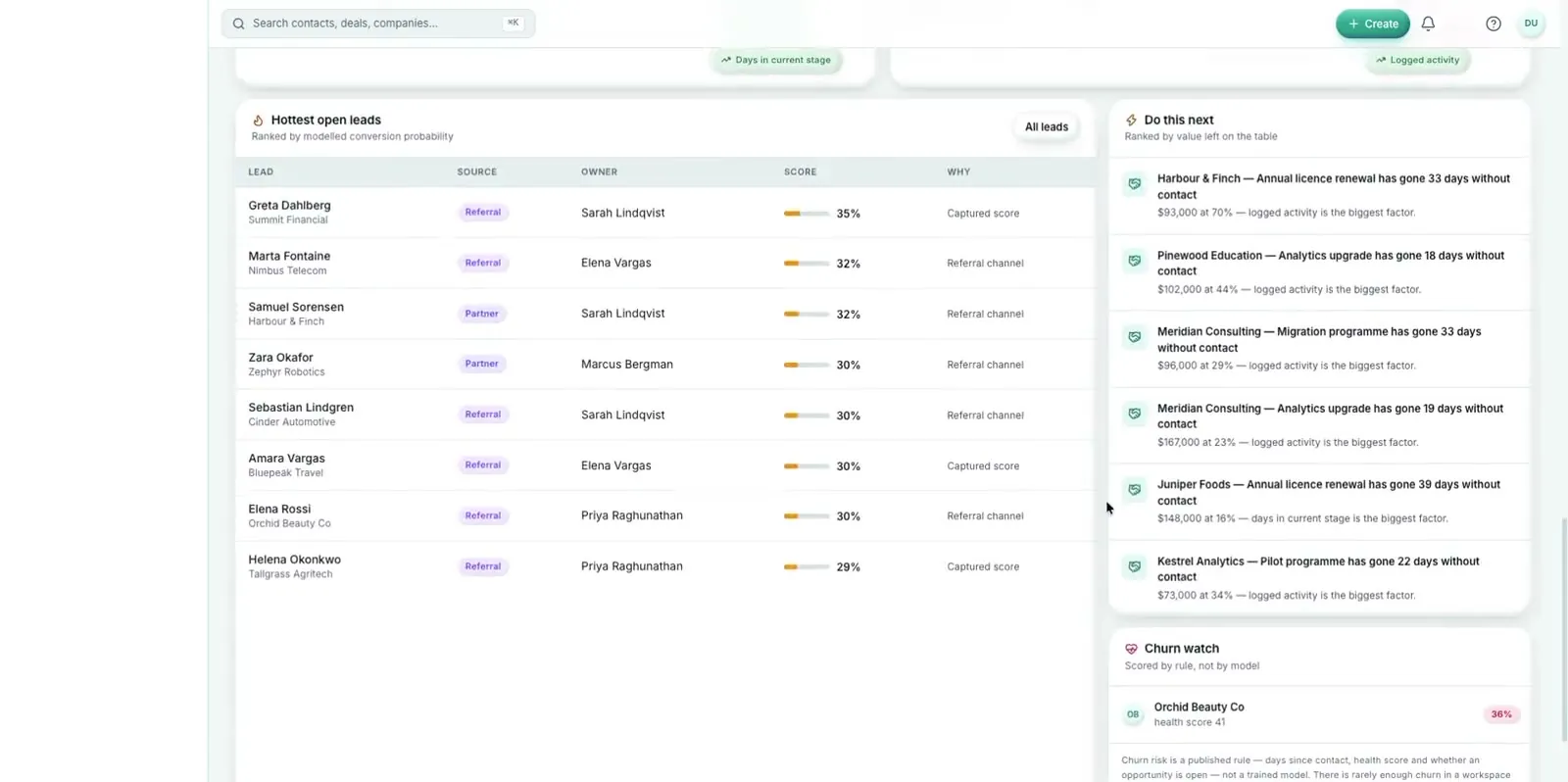
In practice, the best systems combine all three. A workflow handles the predictable backbone, an agent handles the steps that need judgement, and a conversational interface lets people ask questions or approve actions. In Caudify CRMS, for example, outreach follow ups run on a schedule, while the AI copilot looks across the pipeline and ranks what to do next by the value left on the table.
Frequently asked questions
Is ChatGPT an AI agent or a chatbot?
Used in a chat window, it behaves mainly as a chatbot: it responds to each message. When it is given tools, such as browsing, running code or acting in other applications, and works through several steps toward a goal, it is acting as an agent. The distinction is about autonomy and tool use, not the underlying model.
Are AI agents safe to use in business processes?
They can be, with the right controls. Give agents only the permissions a task needs, require human approval for high impact actions, cap steps and spend, and log every step. Start with low risk workflows, measure results, and widen autonomy only once the agent has proved reliable on real cases.
What does it cost to build an AI agent?
It depends mostly on how many systems the agent must act in and how much risk the task carries. A focused agent working with a few well documented APIs is a modest project; a multi agent system across many internal systems with approval workflows is substantial. Mapping the workflow first gives a far better estimate than any rule of thumb.
Getting started
Pick one workflow that is frequent, painful and measurable. Map its steps, decide where judgement is really needed, and start with the simplest approach that works. Measure the result before widening autonomy.
Our agentic AI team builds agents with tracing, approval gates and evaluations, our AI automation team builds the deterministic workflows around them, and AI integration consulting helps you decide which to build first. For keeping any of them reliable, read how to evaluate LLM features in production.